Caribbean Costa Rica
Costa Rica’s Caribbean coast is an entirely different experience from its Pacific counterpart, in both atmosphere and wave options. If the Pacific side is characterized by playful beachbreaks and points, the Caribbean coast is all about shallow, heaving reefbreaks, particularly Salsa Brava, which is the closest thing Central America has to Hawaiian-style power. While still offering a variety of waves for most abilities, the Caribbean coast is best suited for intermediate to advanced surfers looking to challenge themselves in heavier conditions. Naturally, winter is the best time to score on the Caribbean side, when the Atlantic storms are more frequent.
The Waves

Salsa Brava
This gnarled Caribbean reefbreak in Costa Rica has been called Costa Rica's heaviest and best wave. Pound for pound, it's as intense as any coral reef double-up right (and left) tube in the world. There are two general takeoff areas at Salsa. First Peak is a very round bowl section that offers the occasional left tube, as well as occasionally allowing you to backdoor Second Peak (but you have to be going really fast and be a proficient tuberider). First Peak's takeoff zone is tight and generally reserved for experts. Second Peak is just north of First Peak and can shift around a little, allowing for a less condensed and frothing pack. You've still got to take off under the lip, though. In general, the waves aren't really facey -- you're either in the tube or on the shoulder.A mile or so south of town is Playa Cocles, a consistent beachbreak, and a few miles south of that is Punta Uva, a semi-fickle right point. There are a few reefbreaks around the port town of Limon, 50 miles to the north.

Isla Uvita
A half-hour boat ride from Limon, Isla Uvita is an undeveloped, uninhabited, reef-flanked island where Christopher Columbus landed in 1502 on his fourth New World voyage. In peak form the wave is an ultra-gnarly, jacking, bowling, warping lefthand reefbreak with a shallow outside ledge and two dangerously slabby sections thereafter, becoming a tuberiding haven for advanced surfers and bodyboarders experienced in thick-lipped slabs. Uvita picks up any trace of short-interval windswell generated by all the powerful Atlantic storms that crank up in the winter (and to a lesser-degree, summer), and morning windows are optimal; although with all the frequent thunderstorms that coincide with the surf seasons, it’s never onshore for too long on the Caribbean side. Occasionally world-class, sometimes sketchy, but perpetually rideable, Uvita generally has three takeoff sections and can hold up to double-overhead surf and beyond; at which point it becomes one of the freakishly challenging waves in the whole country.

You like heavy slabs, you go to the Caribbean side. There are waves of consequence.

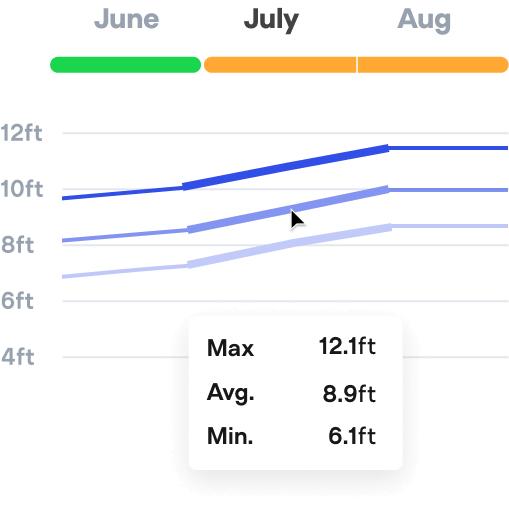
When to Score & Seasonal Surf Data
Know exactly when to score — powered by our expert historical forecast data.
Decades of spot-specific swell info — combined with forecaster insights — show your best chance to score, found only on Surfline.
Time to score

Forecaster reports

Seasonal Surf Data

Caribbean Costa Rica According To...
Carlos
Munoz
Local hero talks local vibes, variety of waves, and the Pura Vida spirit.
What makes Costa Rica a special destination for surfers?
Costa Rica is blessed on both sides, the Caribbean and the Pacific, and there’s waves all year long. Warm water, good food, very clean ocean – it’s a good place to go surf. The people are nice, they don’t want to fight with you over waves. You will connect to nature. It has a lot of good things.
What kind of waves can visiting surfers expect?
Costa Rica is really lucky because it has surf on both coasts. When things quiet down on the Pacific side during the winter months, that's when the Caribbean starts to turn on. You can get these intense, short-period swells in the Caribbean. It can get kind of heavy when it's pumping. When most people think of Costa Rica they think of the Pacific side, but there are some hidden gems on the Caribbean. And to be able to have waves year-round, we are really lucky.
What’s the vibe?
Costa Rica is a place where there is a lot of different cultures. We have Americans, we have people from Israel, Argentina, Brazil…it’s a big mix. If you find yourself amongst the locals, they pretty much like to share. They like the good vibes. One thing that I’ve found is that when I’m around people who are learning, I get excited for them. I get excited for the moment they’re living in—when you’re standing up for the first time or turning for the first time or get your first barrel—I get excited and like to cheer for them. And I feel like most Costa Ricans are like this. We like to share and get excited and cheer when people have fun here.
What should surfers bring?
Bring three boards if you can. One epoxy, just in case you have to do some groveling. And you should bring a step-up. I think sometimes people underestimate how strong the waves get here. And then your regular board. If you can only bring two leave the epoxy at home. You should bring an umbrella in case it’s too sunny or too rainy. A lot of sunscreen. And bring the good vibes. You will find good waves, for sure.
When is the best time to score?
The Caribbean is similar to Hawaii. From December to March, you can find the storms that make the waves over there. It’s pretty heavy. It’s slabby and the energy is a lot different in the Caribbean compared to the Pacific. Also, the Caribbean has reefs, so during those months you can get some really good waves if you are in the right spot. The Caribbean and Pacific are kind of opposite—if it’s raining on the Pacific side, it will be sunny on the Caribbean side.
Then, right when it gets to March, the south swells start to hit on the Pacific side and you start getting lots of lefts. The sandbars and points get really good. When the southwests start to hit in April, May and June you probably have the best conditions on the Pacific side. The winter is a great time for learning. It’s smaller and more gentle. In the rainy season, the only thing is sometimes the water can get a little dirty and the rain doesn’t stop, but the waves are still heavy.
What else is there to do when you’re not surfing?
I just went to visit this place called Arenal for the first time in my life. Man, it’s beautiful. I couldn’t believe it. The mountains, the nature, the hot springs, the volcano…it’s a really incredible experience. There are a lot of trails to walk. You can go to national parks and look for birds and animals. Costa Rica is one of those places that has a lot of reserves, and if you like wild nature, it’s very beautiful. There are a lot of retreats where people like to have a quiet place to go and reconnect with the earth. It’s a very open place for many things.
What’s your favorite local cuisine?
You have all types of good. Gastronomy is very popular in Costa Rica. There are beautiful restaurants. I love gallo pinto. It’s rice and beans, but they have a way of cooking it that’s very good. We mainly eat that for breakfast with eggs, avocado, platano, sour cream. That’s my favorite. We also eat rice and beans with different kinds of meat and fish and vegetables. Handmade tortillas, they have a very particular way of making them. That’s pretty much the local kind of food. And we have steak and sushi and all the fancy kinds of things, too.
Where can people learn to surf?
For people that are just learning there are a lot of beachbreaks. They can be not so strong, so they are not that hard to surf and the water is warm. And with so many people coming here from all over the world, it is not hard to find somebody to teach you or a surf school to take lessons at. It’s a very gentle place to learn—just watch out for the sun. The sun is not so gentle.
What are some things people should be aware of when it comes to local culture and customs?
If you go to a new place, just try to be careful and be aware of your surroundings. You never know what the intentions are of the people around you. If you are in a place with good people, you will have a great time, but you should always be aware. Costa Rica is very safe and the people are very nice, but you never know. Other than that, enjoy it, bring good vibes, have a good time with the local people and the culture. Share some waves, and respect like always.
Travel Essentials

Culture & customs
With dozens of pay-to-play surf camps peppered along both coasts, this politically stable surf oasis regularly accommodates an ever-growing local surf culture, hordes of visiting surfers of all levels, and countless expats who’ve settled here to live pura vida year-round.
Local scene
Costa Rica’s Caribbean coast is different from its Pacific coast in almost every sense. For one, it’s much smaller: only 132 miles of coastline. It’s also much less touristy than what you’d find in the north and central Pacific areas. There’s a lively, disintctly Afro-Caribbean influence that can’t be found elsewhere in the country, so you can expect an entirely different cultural flavor.
What to bring
Mosquitoes abound from dawn and dusk — so bring some high-quality bug spray along with all your tropical surf trip essentials: warm-water wax, sunscreen, rashies, shades, hats, etc. Also, bring rain gear (this is the wettest region in the country), high-performance shortboards or reliable step-ups, ding repair and Neosporin for the sharp and shallow reefs.
Also: Our amazing partners over at FCS have curated a collection of fine products for your next surf trip. Check it here.
How to get there
The most common way to get here is to fly into the capital city of San José and either rent a car and drive the 135 miles to Puerto Viejo, or take a 30-minute domestic flight to Limón. Surfers have also been known to take a bus from Panama or Nicaragua to extend their Central American journeys, but it is exactly that: a journey.
Downtime
Costa Rica’s natural splendor doesn’t stop on the Caribbean coast; if anything, it’s even more tropical than the Pacific. There are coral reefs here, prime for diving. And in the Tortuguero National Park, a handful of sea turtle species make their annual shuffle up the beach to lay eggs (March-May for leatherback nesting season, July-October for loggerhead nesting season, March-October for hawksbill season). Also, the Afro-Caribbean influence is evident in everything from the food to the music in towns like Puerto Viejo and is absolutely worth absorbing between surfs.
Quick Tips
Travel Time
LAX: 6 hrs
JFK: 5 hrs
Heathrow: 11.5 hrs
SYD: 28 hrs
Connectivity
WiFi connection is expected at hotels, other accommodations, some coffee shops, etc. As far as general cellphone reception, it just depends on how far off-the-grid you decide to venture.
Currency
Costa Rican Colón. At the time of writing, $1 USD = 669.15 CRC
Avg. cost of...
Cup of coffee: $2.00
Lunch: $7.00
Beer: $3.00
Hotel room: $150.00
Visa Requirements
No visa necessary for US visitors, unless you plan to stay longer than 90 days.
Drinking water quality
In general, tap water is safe to drink in Costa Rica. However, in more rural areas – like the Caribbean side or the southern region – it’s best to stick to bottled water.
Hazards
Heavy rain, sharp reefs, rough roads, mosquitos, petty theft, board-breaking slabs.
Cash, card, crypto
Although the national currency is the Costa Rica Colón, nearly everywhere accepts USD. It’s always a good idea to have some cash on you, too, so stop by an ATM when in a major city.


Have feedback on this zone? Let us know [email protected]
Questions about booking with Surfline Travel? Check out our FAQs