South Shore Oahu
Big high-rises, small waves, huge parties, heaps of people…that’s what you can expect on the South Shore, especially during winter. But summertime is primetime, when south swells light up the myriad reefs, providing long walls or big bowls from Diamond Head to Barber's Point. That’s when Town surf culture is on full display: Traditionalists cross-step in the Duke’s footsteps at Queens; seasoned tuberiders line up the perfect boomerang at Ala Moana Bowls; local pros practice their air game at Kaiser’s… Winter is pretty slow on the South Shore, while fall and spring see intermittent pulses of south swell. But no matter the season, the South Shore is full of hustle and bustle, in and out of the water.
The Waves

Ala Moana Bowls
Inarguably Town's most coveted -- and famous -- high-performance wave, Ala Moana Bowls has a clearly formed and obvious lineup. The wave is a long left, with a few different tube sections and a range of takeoff spots, but it's at its most focused and perfect when a solid S swell detonates on the outside bowl section. The seabed next to the reef was dredged for Ala Wai Harbor, thus the man-made interference bends swell and refracts it. And even though really big sets are still referred to as Pole Sets, the pole that once indicated such incoming bombs is now gone.The Ala Moana Bowls left can hold solid size and breaks off toward the harbor channel, but Bowls also offers a shorter right on smaller days that will usually end as a closeout section on the very shallow inside reef. As you head west across Magic Island into Ala Moana Park, there are numerous quirky, crowded and hard-to-catch reefbreaks, including Tennis Courts, Big Rights and Kewalo Basin. All of these waves work best on the same swell as Waikiki, though tide and local knowledge definitely comes into play here. *Note: This surf break has bleeding control emergency supplies provided through the Adopt a Cove program. Learn more here.

Waikiki Beach
Waikiki Beach consists of numerous spots that offer rights and lefts, as well as world-renowned crowds. It is one of the birthplaces of recreational surfing and a pillar in the quintessential Hawaiian surfing experience. Surf Waikiki and you'll share waves with people from all over the world, many just learning how to surf. While Waikiki conjures images of small, soft, rolling waves, when there's a solid Southern Hemi swell running, many of its breaks turn on enough to keep the beginners on the inside, leaving the better outside rollers for more experienced surfers. *Note: This surf zone has bleeding control emergency supplies provided through the Adopt a Cove program. Learn more here.

Diamond Head
There are several different spots off Diamond Head that offer rights and lefts -- the best are Lighthouse and Cliffs. These reefbreaks are located a good distance off the point and pick up anything from the Southern Hemisphere, as well as easterly trade swell. However, these breaks will also be the first to blow out with the easterly trade winds, which then opens up the lineup to wind and kite surfers. Cliffs is probably the most popular of the Diamond Head breaks, with both rights and lefts that offer smooth takeoffs and mellower rides. Lighthouse (which, of course, is located right in front of Diamond Head Light) is a bit more high-performance than Cliffs, and also shallower. On larger swells, cross currents can be a factor, especially at Cliffs.

Barbers Point
Barbers Point picks up Southern Hemi swells from all directions, and it can also absorb Northern Hemi energy that has a lot of W in it (between 390-329 degrees) or has snuck under Ni'ihau and Kauai (under 285 degrees). There is a point wave that breaks directly out beyond the lighthouse, but there are a variety of peaks spread out down the beach that offer good surf, depending on swell direction. Due to Barbers Point's exposed location, wind is often a factor.


Kaiser's
Kaiser's is the easternmost surf spot on the Ala Moana reef area. It is very shallow and always has an aggressive crowd. The wave offers a steep, fast, bowly right that will throw a good barrel section off the peak and is fun to backdoor. There is also a decent left, which is usually a little more slopey and will often end in a closeout on the inside, leaving you to negotiate whitewash with very little water between you and the sharp reef. The right, however, spills into a channel, allowing for an easy paddle back out. On the biggest swells, the channel will begin to close out, so beware. *Note: This surf zone has bleeding control emergency supplies provided through the Adopt a Cove program. Learn more here.

Three's
Often considered slightly superior to Four's, Three's can really turn on during a solid south swell, offering up clean, racy righthanders that can barrel quite nicely. As with all of Waikiki's surf spots, Three's can get crowded with all types of surfers, from beginner to ultra-advanced -- especially the latter when the waves are good. Unlike nearby Four's, however, Three's has a deep channel at the wave's end that often makes for clean trips back out to the lineup. *Note: This surf zone has bleeding control emergency supplies provided through the Adopt a Cove program. Learn more here.

Populars
Just west of Canoes, and a hundred yards or so further out, lies the long, curving stretch of reef that's aptly named Populars (or Pop's). It's a peak with a decent right that peels and swings down the line with a few bowly sections towards the inside, and a shorter, fairly mushy left. Occasionally it fires, like on a big S swell. Note: This zone has a rescue station equipped with AEDs, bleeding kits, and other emergency supplies through the Adopt a Cove program. Learn more here.

Canoes
Canoes is named after the proliferation of outrigger canoes that litter the lineup, which have a tendency to come steamrolling at you when you're least expecting it. This is all when it's under three-feet and rather warbly, though. Because when it comes together with a solid S swell and a bit of tradewind, Canoes becomes a super-fast right tube, and those outriggers have a hard time keeping up with the racetrack. Count on sharing the lineup on a four to six-foot day with the South Shore's finest tuberiders. *Note: This surf zone has bleeding control emergency supplies provided through the Adopt a Cove program. Learn more here.

Publics
Publics is one of the most consistent and longest lefts in Town. It's a ways out, and the reef is pretty shallow, so any bit of swell can run along its uneven edge. Getting in and out can be a serious hassle, as those coral heads will pop up at the most inopportune times, and yes, they do hurt. High tide renders the waves a little mushy, though safer, while low tide can be racetracky with the occasional tube section, but the real threat is losing some skin on the reef. It's probably better to try it out first time on a high tide. Outside Castles, the infamous and fickle, big, steamrolling left, sits way outside and towards Diamond Head, comprising an outer reef that stretches all across the bay at Waikiki. *Note: This surf zone has bleeding control emergency supplies provided through the Adopt a Cove program. Learn more here.

Queen's
Right in the heart of Waikiki, on small to medium-sized days Queen's offers a fun but shorter left and a longer right, usually split evenly by a single A-frame peak. On bigger days, the wave turns into a long left -- one of the best on the South Shore, actually -- and a shorter right. This wave can barrel at times, but usually it is just an easy, rippable face. *Note: This surf zone has bleeding control emergency supplies provided through the Adopt a Cove program. Learn more here.

Sandy Beach
This beautiful and somewhat fickle left reef break can get really fun with just the right swell and offshore winds. The spot to surf with a board breaks out front of the rocky outcropping on the eastern side of the beach. However, Sandy's is more known for the crazy beachbreak shorepound. The sand bottom zone of about 250 yards between the two rock outcroppings can get very solid and dangerous wedging hollow barrels (often spitting), but usually all closeouts, just off dry sand or even on it. This zone is not for boards -- bodysurfing only. This is also a common place for injuries, from either the wave pounding you into the sand or falling on other people.

The South Shore of O’ahu is such a special place to surf, not just because of its beautiful waves and scenery, but because of its history. People from all over the world have been coming here for decades to learn the art of surfing.

When to Score & Seasonal Surf Data
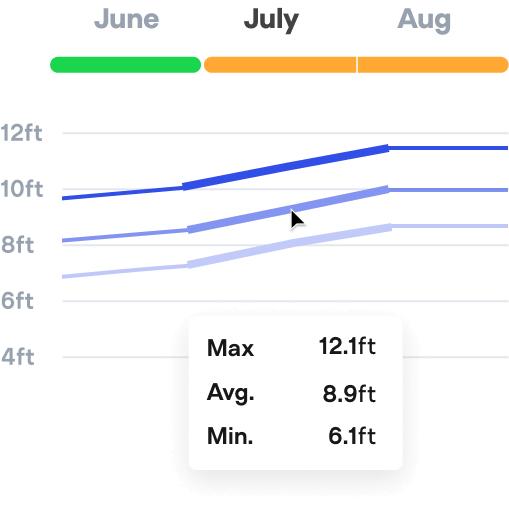
Know exactly when to score — powered by our expert historical forecast data.
Decades of spot-specific swell info — combined with forecaster insights — show your best chance to score, found only on Surfline.
Time to score

Forecaster reports
Seasonal Surf Data

South Shore Oahu According to...
Tara
Sachi
Elegant longboarder and yogi on finding calm in the craziness of Town.
What makes the South Shore a special destination for surfers?
The South Shore of O’ahu is such a special place to surf, not just because of its beautiful waves and scenery, but because of its history. People from all over the world have been coming here for decades to learn the art of surfing. It’s beautiful to see all the different types of people gathering here for the love and curiosity of the ocean.
What kind of waves can visiting surfers expect?
The South Shore has a wide variety of waves, from beginner-friendly all the way up to advanced. Waikiki is the place to learn…you’ll find board rentals, surf instructors, and the perfect gentle and forgiving waves at Waikiki. As you move further west along the South Shore, you’ll find more advanced waves and less forgiving reef.
What’s the vibe?
The South Shore tends to be pretty crowded all year round, with its peak during the summer. The general area of Waikiki offers beginner-friendly waves, and so the crowds reflect that. This is where I would recommend beginners-to-intermediate surfers to go. As you move west, you’ll find the more advanced breaks, which comes with more aggression in the lineup. But even if you are at an intermediate level, you may not be greeted with the same openness and Aloha you’ll find in Waikiki. So, please visit breaks that are appropriate to your level and always show Aloha and respect in the lineup.
What should surfers bring?
For the South Shore surf, I’d definitely recommend bringing your favorite log. However, if you don’t want to travel with it, you can find some great rental spots just a few feet away from the beach. My favorite board rental shop is Moku Waikiki; they have a wide variety of boards, great instructors, and all the gear you’ll need. Also, please leave your sunscreen at home and buy it on the island. You’ll find so many locally-made, reef-safe sunscreens. You may have a sunscreen that says it’s “reef-safe or reef-friendly,” but triple check for these ingredients which are not reef safe: Oxybenzone and Octinoxate. Additionally, look out for Benzophenone-1, Benzophenone-8, OD-PABA, 4-Methylbenzylidene camphor, 3-Benzylidene camphor, and Octocrylene. These can affect corals’ reproductive cycle, damage DNA, and worsen the effects of coral bleaching.
Let’s keep our waters blue and the reefs healthy!
When is the best time to score?
You can find fun waves on the South Shore almost all year round, but April through July you will for sure score.
What else is there to do when you’re not surfing?
There’s plenty of shopping and eating to be done on the South Shore. You’ll find an overwhelming number of options from Waikiki through Ala Moana to Kaka’ako. If you’re looking for more of a hands-on experience, I’d recommend getting involved with the community here and volunteering some of your time. You’ll get to connect with the land and people in a way that is unmatched. In addition, I’d encourage all visitors, old and new, to find a way to deepen your understanding of Hawaiian history to truly be able to appreciate the beauty of Hawai’i.
What’s your favorite local cuisine?
Personally, I eat a mostly plant-based diet, and you will find a ton of options for that here in Honolulu. But on occasion, I do enjoy Kalua pig or chicken Lau Lau. Be sure to find some authentic Hawaiian food while you’re here. Also, there are so many good sushi spots, too. You aren’t living until you’ve tried Poke…and Hawai’i has the best.
Where can people learn to surf?
There are so many surf schools on the South Shore. I’d recommend checking out a few and finding an instructor that matches your vibe. You definitely want to find someone you feel comfortable with.
Any other local tips?
Embrace the spirit of Aloha. Know that whatever energy you put out is what will be reciprocated. Please enjoy our islands with light feet and leave it better than you found it. Support local and small businesses as much as you can. Give love and appreciation to the land and its people, and they will love you right back.
Travel Essentials

Culture and customs
Few places in the world have such a profound historical footprint on surfing than Oahu’s South Shore. It’s where Duke Kahanamoku spawned the modern acceptance and infatuation with the sport. Along with the spirit of Aloha, surfing is the culture of the South Shore. It’s a part of daily life. But this is the island’s most populated areas, too, and it’s packed with tourists from literally everywhere in the world. It’s a big city with an island twist. Locals will paddle out for a morning surf, then come in, change clothes, and punch-in for work. Compared to the hardcore proving ground of Oahu’s North Shore, things are a little more mellow on the other side of the island – from a surfing perspective. But don’t be fooled: things can light up here in the summertime, too.
Local scene
Town is actually a busy city with a population of over 1.4 million people, and high-rise hotels and apartment buildings reach all the way down to the water’s edge. But for the most part, the surf remains the same as it was back in Duke’s day, and the reefs and beaches are still the area’s most valuable asset.
What to bring
All your tropical surf trip necessities and maybe even your own snacks (everything’s more expensive in Hawaii). One thing you don’t wanna bring: your ego. Lock it up and leave it at home. As far as boards, conditions can range from overhead barrels for straight aces on step-ups to perfect rollers for novice cruisers on soft-tops, so it really is a pick-your-poison situation. And there’s tons of rentals.
Also: Our amazing partners over at FCS have curated a collection of fine products for your next surf trip. Check it here.
How to get there
Fly directly into the Honolulu International Airport and you’re pretty much there. Car rentals make it super easy to hop off a plane, pick up a convertible and head straight to Town — about a 20-minute drive from the airport to the heart of Waikiki (depending on traffic). Hawaii’s public transportation system is also easy to use, and it’s free.
Downtime
You can hike to the top of Diamond Head for sunrise, explore the countless beaches outside of the main Honolulu epicenter like Hanauma Bay State Park, which is great for snorkeling, or pay your respects at Pearl Harbor, which includes the National Memorial, the Battleship Missouri Memorial and the Aviation Museum. And, of course, there’s the major metropolitan area of Honolulu, which caters to shoppers, fine diners and nighttime partiers.
Quick Tips
Travel Time
LAX: 6 hrs
JFK: 11 hrs
Heathrow: 17 hrs
SYD: 10-15 hrs
Connectivity
WiFi and cell service basically everywhere.
Currency
USD, Aloha.
Avg. cost of...
Cup of coffee: $3.00
Lunch: $12.00
Beer: $7.00
Hotel room: $200
Visa Requirements
No travel visa necessary for US visitors. Australian travellers can visit Hawaii for up to 90 days without obtaining a visa under the Visa Waiver Program.
Drinking water quality
Safe to drink, primarily local rainwater run through filtration.
Hazards
Crowds, sunburns, paddling straight to the peak, overestimating your limits, ignoring local lifeguards, too many Mai Tais.
Cash, card, crypto
Pretty much everywhere will accept debit or credit cards, but it’s always good to carry some cash. ATMs are available for withdrawals in most urban centers.
Explore Other Zones


Have feedback on this zone? Let us know [email protected]
Questions about booking with Surfline Travel? Check out our FAQs