North Maui
The north side of Maui is defined by its pristine white sand beaches, strong winds, azure blue water, and wide variety of superb waves. Known mainly for hosting the best big wave on earth - Peahi- there’s more to Maui than just heart-stopping 50 ft tubes. Forty miles to the east, for instance, sits Honolua Bay, one of the best right points on earth. In between these two beasts you will find all sorts of reefs, slabs, and wind-swept beachies for every manner of surfer.
The Waves

Peahi (Jaws)
Where the Hana Highway bends away from the ragged sea cliffs of Maui's north central coast, and begins winding south and east through patches of sugar cane fields on its way to Hana, sleeps the surf spot that needs no introduction. First surfed by tow-in pioneers Laird Hamilton, Buzzy Kerbox and Darrick Doerner, Pe'ahi, or Jaws, has become a tow and paddle mecca for big wave surfers the world over. A deep-water wave, Jaws only breaks in the biggest winter swells. If you're a visiting surfer in Maui when such a swell hits, it's worth the trip out to bluffs overlooking Pe'ahi for one heck of a show.

Honolua Bay
Honolua Bay is not only the best wave in Maui, it is one of the best in the world. The northwestern coast of Maui is riddled with bays and crags that can produce all variety of great surf during the winter months, when the North Pacific is busy churning out storm after storm. But even a single-degree change in the angle of a coastline can make the difference between a good wave and a perfect wave. Honolua Bay has just that magical angle, producing a perfect righthander that can line up flawlessly in a series of barrel and turn sections for the better part of a quarter-mile. Like most high-quality pointbreaks, Honolua Bay is broken down into sections: 1. Coconuts: The outermost takeoff zone on the point. As to be expected, the waves will be biggest here, but the wind will also be strongest; 2. Outside: After hitting Coconuts, the wave begins to gather steam and form and will stand up into a hollow wall that offers the first of multiple barrel opportunities; 3. Cave: The best, most popular and high-performance section of the wave. At Cave, wave height gives way to wave thickness as swell runs down the point, offering up the opportunity for the barrel of a lifetime. This section is named after the hole in the reef that gobbles surfers and surfboards with reckless abandon during big winter swells; 4. Keiki Bowl: If you've made it through Cave on a proper set wave, you're probably burning off the steam of a deep barrel, which will get you into the next section, Keiki Bowl. Keiki is smaller, racy, and breaks over shallow, sharp reef -- a favorite of groms not quite ready for graduation to the outer takeoff zones.

Rainbows
Located on the far western edge of Maui in the resort mecca of Kaanapali lies Rainbows, a collection of peaks in the shadow of the Kaanapali Beach Club that picks up both summer S swells and winter N swells, though nearby Moloka'i, Lana'i and Kaho'olawe islands do shadow a lot of it. The quality of Rainbows' lefts and rights are dependent upon season, but no matter the swell direction, you're guaranteed a crowd in the water. You can also count on favorable winds, as Maui's dominant ENE tradewind is offshore at Rainbows. On larger swells, especially those in winter, the right at Rainbows can be a good barrel.

Kahului Harbor
Located on the north-central coast of Maui is the Kahului Harbor, which is a worthy and super-fun place to get your feet wet. There are several good breaks inside and outside of the harbor, which all light up on a solid N swell, but the best wave is the right on the west side of the harbor. Large swells push through the wide entrance with energy refracting out of the deeper channel and crossing up with swell energy reflecting off the jetty, creating a powerful roll-in wedge over shallow water. This mini-Box-like wedge is a favorite of bodyboarders and surfers adept at negotiating abrupt steps and chucking barrels. There is a left off of this same peak, but it dumps into the deep water of the channel, thus not offering much. On top of that, watch out for urchins, rocks, tricky rip currents, pollution, and sharks. Despite the many obstacles, a Kahului Harbor right tube is an experience worth attempting.
Ho’okipa
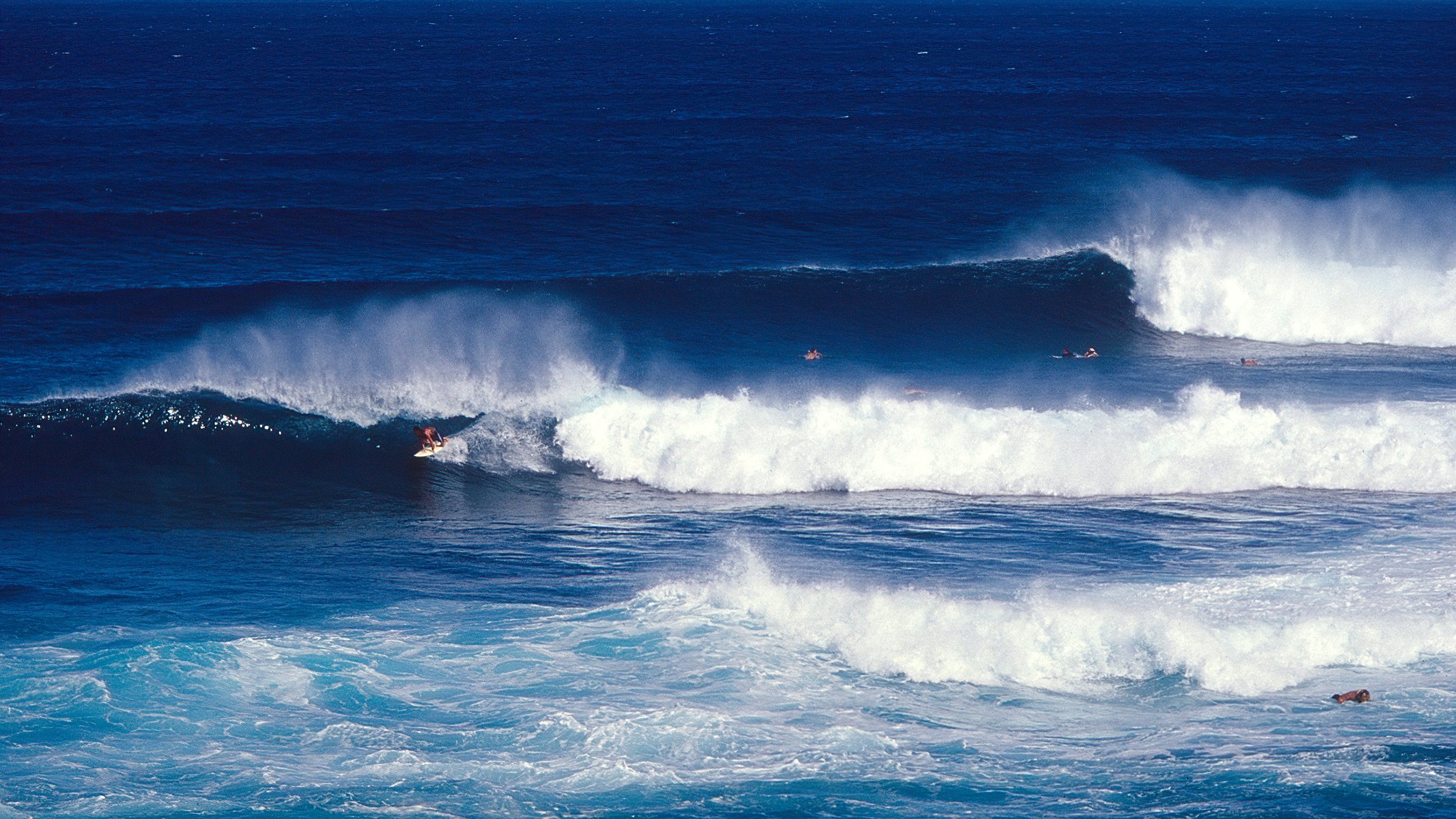
Wind/kitesurfers and paddle surfers actually play quite well together at Ho'okipa Beach Park, on Maui's north-central coast. With a mostly unobstructed window to the North Pacific, Ho'okipa can pump out some serious surf in the winter months -- usually best for surfers in the early-morning hours when the predominant E-NE trade wind has yet to flair up. Ho'okipa consists of four different spots: 1. Pavilions is the most easterly spot, just below the Ho'okipa Lookout. Pavilions is predominantly a righthander; 2. Heading west from Pavilions is Middles, the main spot for surfers. The wave breaks both right and left, though the lefts handle the wind better; 3. H'Poko, or Point, is located on the west end of Ho'okipa Beach. Point offers up fun righthanders in the morning but becomes the sole domain of the wind/kitesurfers in the afternoon; 4. Just west of Ho'okipa Beach is Wana Beach, where Lane is located. You can pick off both rights and lefts at Lane, but like the Point, Wana gets blown to bits in the afternoon.

There’s such a vast amount of different waves. You have everything from pointbreaks, to sandbars, to slabs, giant surf, little surf.

When to Score & Seasonal Surf Data
Know exactly when to score — powered by our expert historical forecast data.
Decades of spot-specific swell info — combined with forecaster insights — show your best chance to score, found only on Surfline.
Time to score

Forecaster reports
Seasonal Surf Data

Maui According To...
Ian
Walsh
Big-wave legend offers up some advice for your next visit to the Valley Isle.
What makes Maui a special destination for surfers?
I think Maui is really unique in the variety of surf. There’s such a vast amount of different waves. There are everything from pointbreaks, to sandbars, to slabs, giant surf, little surf. And for every in-between day there’s a bunch of wind sports to do as well. There’s a lot of versatility here, and if you have the ability in all kinds of different surf, Maui is a great place that can give you an opportunity no matter what the swell forecast is. And the unique thing about islands, as we all know as surfers, if the wind is onshore on one side of the island it’s offshore on the other.
What kind of waves can visiting surfers expect?
With a lot of swell here there are a lot of fun locations that can flair up. Even in the offseason, the summer months, you can find different kinds of waves. Obviously, winter is main focal point with popular waves like Jaws and Honolua, but I think the biggest thing about Maui is how many different kinds of waves there really are here. I think that directly influences the type of surfer who comes from here and how versatile they are. All the good surfers from here have a very creative ability to surf in all kinds of different waves. It’s like anywhere, there can be incredible, world-class days, but it can also be fickle in terms of when really, really good waves flair up. On average, there’s a lot of consistent, fun waves here. It’s known as a windier location, absolutely, but in winter when the swells are pinpointed towards Hawaii, it does seem to find a lot of light and variable days.
What’s the vibe?
The vibe is really good. I’m a little bit biased, obviously, because I grew up here. But I’ve spent a majority of my life traveling around the world experiencing different locations and cultures, and they all have great details, but there’s something that just feels good about Maui. There’s really good people, there’s a really good energy and there’s a very active community here. And I feel like there are a lot of like-minded people here on Maui, and I think that leads to creating a strong sense of community. It attracts very cool people. Like anywhere in the world you surf, everyone knows there can be heavy components to surf locations, but there’s also a light component everywhere you go. It’s just depends on how you look at it and how you approach it. If you approach everything respectfully without much of an ego, you’re going to be much more welcomed. I think what makes Maui so special is not just the surf, but the people that are here too.
What should surfers bring?
Bring your reef-safe sunscreen, that’s a big thing on Maui. And in terms of surfboards, it just kind of depends on what your ability is. That’s the great thing about Maui, you can learn to surf or ride the biggest wave of your life. Something to keep in mind is the know what your ability is and bring the equipment that suits that. The waves are really powerful here, the conditions change very quickly.
When is the best time to score?
The Northern Hemisphere winter is the season for big waves and when the marquee spots light up, but even in the summer months there are waves. We get south swells and cyclones and tropical storms in August and September, which open up these unique locations on the island that we don’t normally get to surf. So, there is year-round waves.
What else is there to do when you’re not surfing?
Maui has a bunch of stuff to do. It just depends on what kind of trip you’re on. If you’re here as a couple, you can definitely be “paradising,” as we like to call it. You can go to some parts of the island an experience that Hawaii paradise vibe. There’s incredible hiking, cycling, mountain biking. Outside of surfing, you’re here in the summer months and there’s not much south swell you can tap into the wind sports on the north and south sides of the island—downwind foiling, downwind paddling, sailing, canoe racing, there’s a lot of other stuff to do. It took me the majority of my life to actually turn around, I was so fixated on the ocean and what the waves were doing, then I turned around and looked up at the Maui mountains and there’s so much stuff to do there…wineries, lavender farms, horseback riding, downhill mountain biking. There’s a lot of different components to Maui that make it really beautiful outside of the surf.
What’s your favorite local cuisine?
There’s also a lot of good places to eat. Some of the quieter sides of the island really do have good local food. Obviously, there are tourist destinations and some very fine dining options, but the local food is really good and fresh.
Where can people learn to surf? Any surf schools you’d recommend?
If you’re really a beginner, I would recommend linking up with one of the surf schools here or take some private lessons. There are a lot of really good surfers from Maui that do lessons here. There’s great locations that they have permitted access for that are really safe and very forgiving waves. There are a lot of really good surfers here that surf when the waves are giant, and when they’re not they’re teaching surfing. I think if you’re just learning that somebody like that would really help enhance the experience and teach you a lot about the place and the waves.
Any other local tips?
I would say a big tip here too is to not use a super thin comp leash. The waves are notoriously powerful and your leash can break pretty easily at locations where your board will end up on the reef or rocks, I see that happen quite a bit. Use a normal thickness leash—you’re not trying to compete against Italo [Ferreira] in waist-high waves. Also, be respectful of the people who live there and the surfers who devote their lives to these spots.
Travel Essentials

Culture & customs
Just like surfing is a Hawaiian sport, Aloha is a Hawaiian custom. Honor the traditions, be humble and patient. A smile and a shaka go a long way. When paddling out, sit, watch and wait your turn. If you want a shot at a decent wave at any of the top spots, you’ll need to pay your dues and earn your place in the lineup. Thousands of surfers visit the islands every year, but this is a sacred place. Follow the rules, know your limits, respect the people and the environment… And take your sandals off before entering anyone’s home.
Local scene
Although Maui is much mellower than Oahu, don’t expect that island-style cruisiness to translate to the waves. In the wintertime, some of Maui’s best (and biggest) waves light up on the northern coast of the island. Jaws is probably the most perfect big wave in the world and requires loads of XXL experience. Honolua Bay is a world-famous righthander with a significant pecking order and it’s way more dangerous than it looks. There’s plenty of other legit, less-publicized spots, but respect is mandatory everywhere — respect for the surfers and respect for the waves.
What to bring
All your tropical surf trip necessities and maybe even your own snacks (everything’s more expensive in Hawaii). One thing you don’t wanna bring: your ego. Lock it up and leave it at home. There’s something for everyone here — from beginner waves to high-performance spots to big waves to wind sports — so bring your board of choice. Or don’t. Local shops will sell you anything you need.
Also: Our amazing partners over at FCS have curated a collection of fine products for your next surf trip. Check it here.
How to get there
Kahului Airport is the main airport in Maui, offering flights to and from the mainland, other islands and beyond. Your best bet from there is getting a four-wheel-drive rental car to explore the island. You’ll likely find yourself on some dirt roads.
Downtime
From national parks to helicopter tours to golf courses to snorkeling to fishing excursions – the options on Maui are vast. Most non-surfing options on Maui involve hiking, like Pipiwai Trail (which has three waterfalls), Iao Valley State Park and Kapalua Coastal Trail. Haleakala National Park is home to one of the world’s largest dormant volcano craters, standing more than 10,000 feet above sea level at its summit. For less adventurous activities, there are good shopping, dining and nightlife options in more urban areas like Lahaina.
Quick Tips
Travel Time
LAX: 5 hrs
JFK: 10.5 hrs
Heathrow: 17 hrs
SYD: 15-20 hrs+
Connectivity
WiFi and cell service basically everywhere, except in the rural areas (which there’s a lot of.)
Currency
USD, Aloha
Avg. cost of...
Cup of coffee: $2.00
Lunch: $12.00
Beer: $5.00
Hotel room: Depends. Everything from cheap hostels or Airbnb’s, to swanky hotels running a couple Gs a night.
Visa Requirements
No travel visa necessary for US visitors. Australian travellers can visit Hawaii for up to 90 days without obtaining a visa under the Visa Waiver Program.
Drinking water quality
Safe to drink.
Hazards
Paddling straight to the peak, overestimating your limits, ignoring local lifeguards, breaking your leash and losing your board on the rocks, being blown away by the winds.
Cash, card, crypto
Pretty much everywhere will accept debit or credit cards, but it’s always good to carry some cash. ATMs are available for withdrawals in most urban centers.
Explore Other Zones


Have feedback on this zone? Let us know [email protected]
Questions about booking with Surfline Travel? Check out our FAQs