Morocco
A colorful blend of desert vistas and azure water, the north African country of Morocco is the quintessential exotic surf destination. From the noisy bazaars of Marrakesh to the romantic vibes of Casablanca, Morocco has much to offer the intrepid traveler—and if you have a penchant for right-hand point breaks, you’ll quickly find yourself right at home, despite the constant barrage of foreign sights, smells, and sounds.
The Waves

Anchor Point
Anchor Point is Morocco's most legendary wave. It's a long right point that runs along a rock shelf, with hollow sections and lots of room for high-performance surfing. It's easy location in the town of Taghazout and its consistency in the winter months make it the center of surfing in the region, although there are at least four world-class breaks within driving distance, so the crowd spreads out and epic sessions abound. LINEUP TIPS: Etiquette | Surf Safety Basics

Safi
Previously a semi-secret Moroccan gem, Safi has gotten a healthy dose of attention over the past few years as pros and barrel-hounds have chased and documented a handful of notable swells recently. One of the best barreling sand points in Morocco (if not the world), but also fickle, rare and extremely heavy.

The Money Wave
The powerful, consistent right-hander previously known as the Money Wave has all but disappeared off the traveling surfers' list of Moroccan surf spots in the past decade. While its appalling location in front of a huge, noisy factory is largely to blame, the waves are as good as ever.Follow the coast south from Safi until you come to the huge factory. Pull up in the dirt lot in front and you'll find a long reef of right-handers that picks up a lot of swell. There are barrels and big faces for lots of turns, challenging enough for the best surfers.Staying in Safi is the best option, which allows you to check the coast and other spots on the drive down. The factory is depressing and noisy and makes the water quality dubious, although it looks clean and green enough it's still not an ideal place. But if you're looking to get some solid peaks and pull into a few, here's the place.The locals surf it and are happy to share when they're around, and if you make friends with them they might lead you to some of their more secret reefs down the coast south of the factory, where the landscape is beautiful and the road winds along the hillside.

Imsouane
A consistent, long, mellow, righthand point, The Bay is the prototypical beginner/surf school spot in Morocco. That being said, it is also a blast on a log or fish, even for experienced surfers. Arguably the longest wave in Morocco. There are also left and right reefs, beachbreaks, and points around the corner, on the Cathedral side.

Boilers
The first spot heading south as you round the headland of Cap Ghair is a zippy right-hander visible in the distance from the road. The prevailing winter winds blow offshore, making the area the capital of Moroccan surfing with several world-class waves within an hour's drive of each other, all centered around the town of Taghazout.The right pointbreak called The Boiler is named for the rusty hull of a ship that sits just underwater at the top of the point. Its boiler is visible and gurgling at low tide. The wave is a quick runner that breaks along the urchin-covered rocks with a lot of speed and punch. Lower tides are best as they give it more zip but be careful at the paddle-out as the rocks are covered with sea urchins.The place works from waist high to double-overhead and bigger, and when the swell is solid and the crowds spread out over the region's various waves. The Boiler can offer a dream session of offshore winds and overhead sets that will have you hooting your friends as you paddle back up the point.Located on the far west end of the cape, it picks up more swell than the famed Anchor Point and is a good option if the swell is small. Camping in the dirt on the cliff will have you out at dawn, but there's nothing out there at night but stars.

Killers
One of the main point breaks in Taghazout and the most open to swell, Killers lies at the centre of Moroccan surfing. It is a long, powerful right point that can handle the biggest swells, and can be more challenging than Anchors' more groomed lines. A long paddle from the sharp, rocky beach and the current on big swells can make it a chore to get out there.

Just enjoy the country. Be open to seeing different landscapes and surfing long, long rights.

When to Score & Seasonal Surf Data
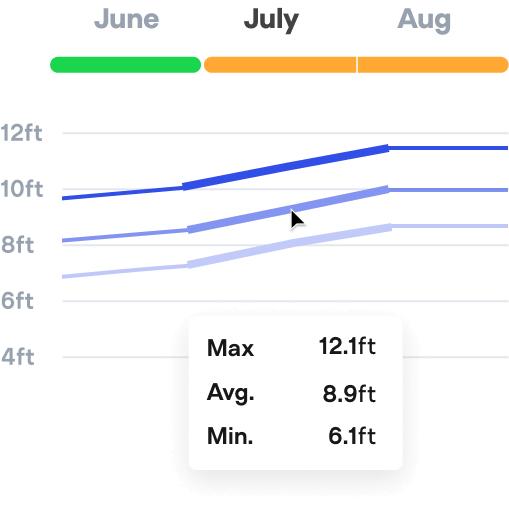
Know exactly when to score — powered by our expert historical forecast data.
Decades of spot-specific swell info — combined with forecaster insights — show your best chance to score, found only on Surfline.
Time to score

Forecaster reports
Seasonal Surf Data

Morocco According To...
Othmane
Choufani
Moroccan charger gives a tour of his beloved, right point-riddled coastline.
What makes Morocco a special destination for surfers?
Morocco is comparable in many ways to what Mexico is for Californians, and what Bali is for Australians. It’s pretty close to Europe, where cheap flights on various airlines make it an easy trip. There’s good waves with amazing weather all winter long, especially in Taghazout. Morocco has many good, long, right pointbreaks, as well as safe beaches to learn. The food is good and cheap, and there’s all types of accommodations, from luxury places like Paradis Plage or Fairmont to backpacker-style hostels and surf camps.
What kind of waves can visiting surfers expect?
In the Taghazout area you’ll find mostly fun, long right pointbreaks that are good for shortboards, with more hollow sections for getting tubed at low tide. We’ve got slabs, big waves, outer reefs, points, wedges… You name it.
What’s the vibe?
We Moroccans are welcoming and friendly people. But with the amount of surfers that come to Morocco, we expect respect in the lineup, and for people to not come surf the points if they can’t duck-dive, stuff like that. It got out of control for a bit in Safi — super crowded with everyone dropping in on everyone — but I heard it’s getting better. The crowd can be a bit aggro at Anchor Point, but elsewhere it’s usually fine. The owners of the surf camps should take more responsibility. Most of them are doing a great job, but there are a few that are doing everyone wrong. We’ve seen beginners paddling out at Anchor Point and ruining everyone’s sessions, just clueless. So, the crowds at the most known points can be nuts sometimes, but if you drive further north of Taghazout, there’s always a point or two that are less crowded.
What should surfers bring?
I’d bring an everyday shortboard for the points, then a fish or a twinnie, as well as a step-up for when it gets bigger. Sometimes there’s a lot of current and some foam is nice. Extra sunscreen, for sure, people tend to forget how strong the sun is. As for wetsuits, bring a warm 3/2, or a 4/3 for the early-morning sesh or sunset. In the winter, once the sun goes down it gets pretty chilly.
When is the best time to score?
Your best bet is from January through March.
What else is there to do when you’re not surfing?
There’s good golf courses. And be sure to go visit the souk (local market) and help support the community there.
What’s your favorite local cuisine?
I love tagine of kefta (meatballs).
Where can people learn to surf?
There are plenty of surf camps that offer lessons. Paradis Plage hotel has a surf school in the Taghazout area.
What are some things people should be aware of when it comes to local culture and customs?
Around the surf town the vibe is always pretty cool. People in Morocco are open-minded and welcoming of different cultures. Something to know, though: don’t bring a drone to film. It’s not allowed and will be confiscated while you’re on your trip and given back to you at the airport when you leave.
Any other local tips?
Just enjoy the country. Be open to seeing different landscapes and surfing long, long rights. But don’t forget to respect the local surfers. And if you have an old board or wetsuit, people here will be happy to give it another life. Also, make sure you have a good leash while surfing the points. Many brand-new boards end up on the rocks because of old leashes.
Travel Essentials

Culture & Customs
While major cities such as Tangier, Casablanca, Rabat, and Marrakesh are straight out of Arabian Nights, the heart of the local surf culture lies in smaller, quieter coastal villages and towns such as Taghazout and Imsouane. The local color is an inviting mixture of Arabic culture, Berber, Islam, and hospitable desert fishermen. Female travelers have been known to face harassment in parts of Morocco, though much less so in the surf hub of Taghazout. It’s advisable to book into a surf camp along that stretch, where you’ll meet an eclectic mix of like-minded travellers. Meanwhile, just offshore lie dozens of world-class point breaks that have made the country the stuff of legend with regular-footers in search of endless aquatic perfection. Depending what you are looking for, you can post up in a posh surf camp, get lost on a feral, solo mission to the middle of the desert, or mix it up with hundreds of backpackers at local surf schools. With so much variety and an endless expanse of wave-rich coastline, there’s something for just about everyone.
Local scene
The major surf zones are widely known and heavily frequented, so don’t expect to score Anchor Point to yourself. That said, there are a lot of quality setups, and when swell pours in from the Atlantic, it tends to do so with consistency and power. The lineups are full of local rippers, visiting pros, Euro backpackers, and itinerant jetsetters, all of whom are looking for the same thing—quad-burning right-handers that radiate for hundreds of meters around picturesque headlands. If you are looking for a more solitary experience, your best bet is to explore the coast in a 4x4, where you will find hundreds of miles of uncharted points, beach breaks, and even slabby reefs.
What to bring
In terms of boards, your Moroccan quiver will depend on where you plan to surf and what sort of a surfer you are. A lot of backpackers and surf schoolers make their way to the main surf hubs, and most end up riding longboards at the smaller, inside peelers. If you are an experienced surfer, you’ll want to bring shortboards and step-ups geared toward racy points (think of the high-performance shred sticks and round-pin step-ups you’d take to Rincon or J-Bay), but you can get away with riding just about anything in Morocco, from fish and mid-lengths to whatever other esoteric shapes you might have on your rack. While gear is available in the main towns, it’s worthwhile bringing your own wax and other accessories, particularly if you intend to head out into the desert and explore. It is also a good idea to pack some modest clothing, as the local culture is a bit more conservative than you may be used to, particularly outside of the main surf and tourist zones.
Also: Our amazing partners over at FCS have curated a collection of fine products for your next surf trip. Check it here.
How to get there
There are a few main options for getting to Morocco, and which you choose will depend on your starting point, budget, and preference. Regular international flights land in Marrakesh and Casablanca, which both offer close proximity to Safi. Meanwhile, Agadir is the closest international airport to Taghazout, which has historically been the center of the surf scene. For those looking to road trip down from Europe, there are ferries across the Strait of Gibraltar from Tarifa and Barcelona in Spain to Tangier, as well as a popular route from Almeria to Nador.
Downtime
Morocco is a colorful, culturally rich country with interesting locals and invigorating towns. Get lost in Souk al Had or explore nearby Paradise Valley if you are based in Agadir. Marrakesh is another cultural hotspot if you are based nearby. Ornate mosques are a unique visit for those who are interested in religion, while the local cuisine is incredible (try the tagine!) and the hammams (steam bath) are a great way to recover after a week of all-day surf sessions. Or you could visit Casablanca and relive the ultimate Hollywood romance —here’s looking at you, kid.
Quick Tips
Travel Time
LAX: 12.5 hrs
JFK: 8 hrs
Heathrow: 3 hrs
SYD: 35 hrs+
Connectivity
Morocco has readily available Wifi in cities and large towns; things get a little less reliable when you’re off hunting waves. An international upgrade to your cellphone isn’t a bad idea.
Currency
Moroccan Dirham. At the time of writing, $1 USD = 9.94 MAD
Avg. cost of...
Cup of coffee: $2.00
Lunch: $10.00
Beer: $5.00
Hotel room: $150.00
Visa Requirements
No need for a visa, unless you plan on staying for more than 90 days.
Drinking water quality
Best to stick to bottled water.
Hazards
Petty theft, getting ripped off or scammed, cultural disagreements, noodle legs from the long, reeling righthanders.
Cash, card, crypto
ATMs are available in most major cities. Businesses in major cities will also accept most credit cards. But some cash when you’re off hunting waves isn’t a bad idea.
Explore Other Zones


Have feedback on this zone? Let us know [email protected]
Questions about booking with Surfline Travel? Check out our FAQs