San Diego
With a clearly cruisier vibe than many SoCal zones, from Imperial Beach down by the Mexican border, up to wave-rich Oceanside in North County, you’ve got a whole lotta options to choose from in San Diego County. From reefs around Cardiff and La Jolla to heavy water peaks like Black’s to the miles of open beachbreak in North County, there's often a wave for anyone and everyone here.
The Waves

Oceanside
Although sandbars move and shift along this stretch continually, there are consistent breaks on the north end at the harbor's north and south jetties, and on both sides of the pier. These spots will most often have a crew of surfers on them, but, on better days, the peaks up and down the beach will be just as good. Oceanside is angled to receive southwest swells more readily than the beaches of central San Diego County, and, during southwest swells, it attracts surfers from all parts of SD. LOCAL RESOURCES: SD Surfrider Foundation | Oceanside Boardriders Club | Oceanside Longboarding Club | California Surf Museum

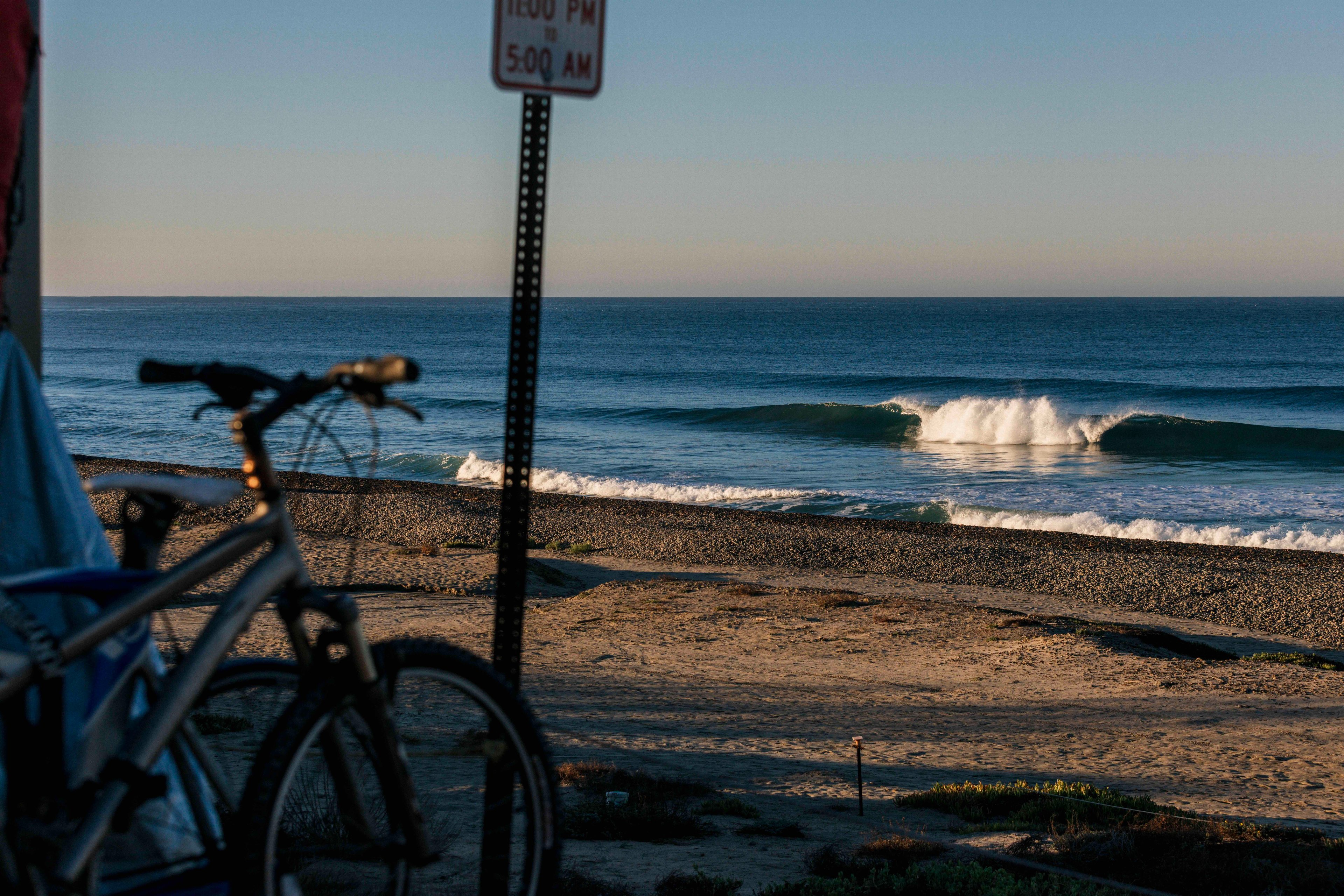
Ponto
For years, this stretch of sand in South Carlsbad was indecipherable from the miles of other average beachbreak in the area. But, as some spots fade into obscurity over the years, others rise to center stage. Ponto is one case where the Army Corps of Engineers have done some good for the area's surfers, when they decided that the Batiquitos Lagoon needed to be opened up on a permanent basis. They constructed two large jetties that, since then, have proven to be a virtual sandbar factory. Newly formed banks don't stay secret for long. Ponto breaks year-round, with rights funneling off the south jetty during the winter and lefts reeling off the north jetty during the summer. Since the lagoon is constantly flowing, watch for a nasty rip that'll suck you out to sea.

Swamis
Swami's. The right point, a rarity in San Diego, needs a decent swell to show a hint of its potential, but it's generally the daily hub of North County surfing during the winter months. On crowded days, even the most skilled shortboarders find themselves battling for leftovers on the inside, while the established crew has its way on the outside. This is not necessarily a bad thing, being that the smaller waves are usually steeper and offer a couple of bowl sections. Pretty much any wave at Swami's is a good wave, and a rider is guaranteed at least one or two sections to hit even on the worst of days. The drop is generally mellow, and then the wave races across a shallow ledge on the inside until it eventually hits a huge channel. Depending on the tide, the wave breaks with varying degrees of steepness. Obviously, lower tides make for the speediest waves. There is a short left that can be surfed if you are getting so shut down on the right that you need something just to keep the blood flowing. If this is the case, paddle deeper than the rest of the pack and sneak off to the left. Swami's can handle as big of a swell as the Pacific cares to throw its way-and gets better as the size increases. LOCAL RESOURCES: Swami's Surfing Association | San Diego Surfrider | Bring Back Our Beaches LINEUP TIPS: Etiquette | Surf Safety Basics

Seaside Reef
Seaside Reef is predominantly a left that can suck out on the takeoff, then flatten out on the shoulder before reforming into a quick and whackable shorebreak. The right off the peak is much softer, but with a bit of effort, it can be milked along to the same inside section. On extreme low tides, the left will produce some serious tubes. On days without much swell and a high tide, the inside shorebreak can be a fun option.

Del Mar
Del Mar is home to a rare reefbreak amid miles of beachbreak. From La Jolla in the south, to Seaside/Cardiff in the north, 15th Street is the only clear relief from the monotonous sandy sea floor. When the beaches are closed out on a low tide or a big swell, 15th will produce shapely lefts and a short right-hander.On the cliff above the lefthander is a well-kept grassy park, which serves as a great place to hang out between surfs. Also, alongside the road is a loading zone with a perfect view of the lineup. Parking is available in a pay lot directly across the street, but, another 100 yards to the north, you can park for free in the surrounding neighborhood.The reef at 15th Street sticks out just far enough to pull in some of the south swells that generally pass by the rest of San Diego, but the wave is much more consistent during the winter. The spot can work on just about any tide, but gets steeper and more powerful as the tide drops. The left can line up and race along the edge of the reef, allowing for three or four turns down the line. The right is a little mushier and shorter, but does have an occasional section to bash. On its best day, the left can be somewhat comparable to the left at Lower Trestles. The wave breaks a fair distance from shore, and can have a reform on the inside during higher tides. It doesn't blow out as easily as its neighboring beaches because it's a reef and has some traces of kelp growing below the surface.If there is a crowd at 15th, you can always find a peak to yourself to the north or south, so long as the wind isn't already on it. These sandbars can be pretty fun, but can't handle any real size or a low tide. You can, however, be assured to surf either alone or with just a couple of other surfers. Beware of summertime restrictions on surfing and swimming zones on all beaches north of 15th Street, and be very cautious of the pollution problem at the rivermouth. LOCAL RESOURCES: San Diego Surfrider | Del Mar Bodysurfing Club LINEUP TIPS: Etiquette | Surf Safety Basics

Blacks
This is the best beachbreak in the county, and everyone knows it. The saving grace here is the long hike due to the sheer cliffs. It requires a time commitment that rules out most before-the-job or lunch-break sessions. There are three main peaks, shifting phantom peaks and sneaky insiders that work according to conditions. A deepwater canyon attracts most any swell with west in it and holds waves from 2 feet to as big as it gets. During head-high and smaller swells, low to medium tides are best, but, during large swells, it's less tide sensitive. It should be obvious, by the glider port on the north end, that the dominant wind is onshore. Worth noting: the northern end of Black's has long been a celebrated nudist beach. LOCAL RESOURCES: San Diego Surfrider LINEUP TIPS: Etiquette | Surf Safety Basics

Scripps
Scripps Pier, home of the Scripps Institute of Oceanography, can occasionally have more defined sandbars, especially on the south side, than ones found just south at La Jolla Shores. Sandbars tend to get more defined after big swells and/or periods of rain. LINEUP TIPS: Etiquette | Surf Safety Basics

Pacific Beach
Pacific Beach/Crystal Pier almost always has something to ride but is rarely truly good. It tends to close out on any longer period swell that creates surf in the overhead range, especially as you move away from the more defined sand bars of the pier. However, on the occasion that a combo of swells from the northwest and southwest is greeted by easterly wind (generally in the fall) fun peaks can be found up and down the beach. The other time this zones comes closest to shining is during short period northwest swells that most frequently happen in the spring.

Ocean Beach
Ocean Beach receives all kinds of swell, and often offers rideable waves when the rest of central San Diego is dry. On the north end, Big Jetty is a hollow right breaking off the southern jetty of the Mission Bay entrance. It begins with a steep peak and a small takeoff zone, but then elongates into a long, fast right wall — the sections depending on the sandbar and swell direction. Both sets and insiders are similarly shaped, and the wave, although preferring a mid to low tide, will break well on just about any tide. Closeouts are the rule with swell pushing eight-feet-plus. The thing to consider here is the San Diego River. Closures are frequent due to runoff from storm events and sewage spills, and the jetty breaks directly in front of Dog Beach, the only area beach where dogs are allowed to run (and poop) free.Avalanche is a predominantly left peak that breaks just north of the finger, or little jetty, bisecting Ocean Beach. It's consistent, breaks on a variety of tides, and will hold just about any swell with a little W in it. Various peaks form just north of the main peak, holding both rights and lefts. It gets quite crowded. The Ocean Beach Pier at the end of Newport Street is the most accessible spot in an area of accessible spots. Both right and left peaks, the OB Pier is temperamental, shifty, unpredictable, perennially surfed and most often mediocre. This is not to say that it doesn't have its good days. When it is working well, usually the right peeling into the pier is the main attraction. There's a mushy, rock-and-sand left on the south side of the pier that often shoots surfers through the pier's pylons at a snail's pace. Like other local spots, the breaks around the pier are happiest on a low to mid-tide, a swell with a little W in the mix, and light wind. LOCAL RESOURCES: San Diego Surfrider
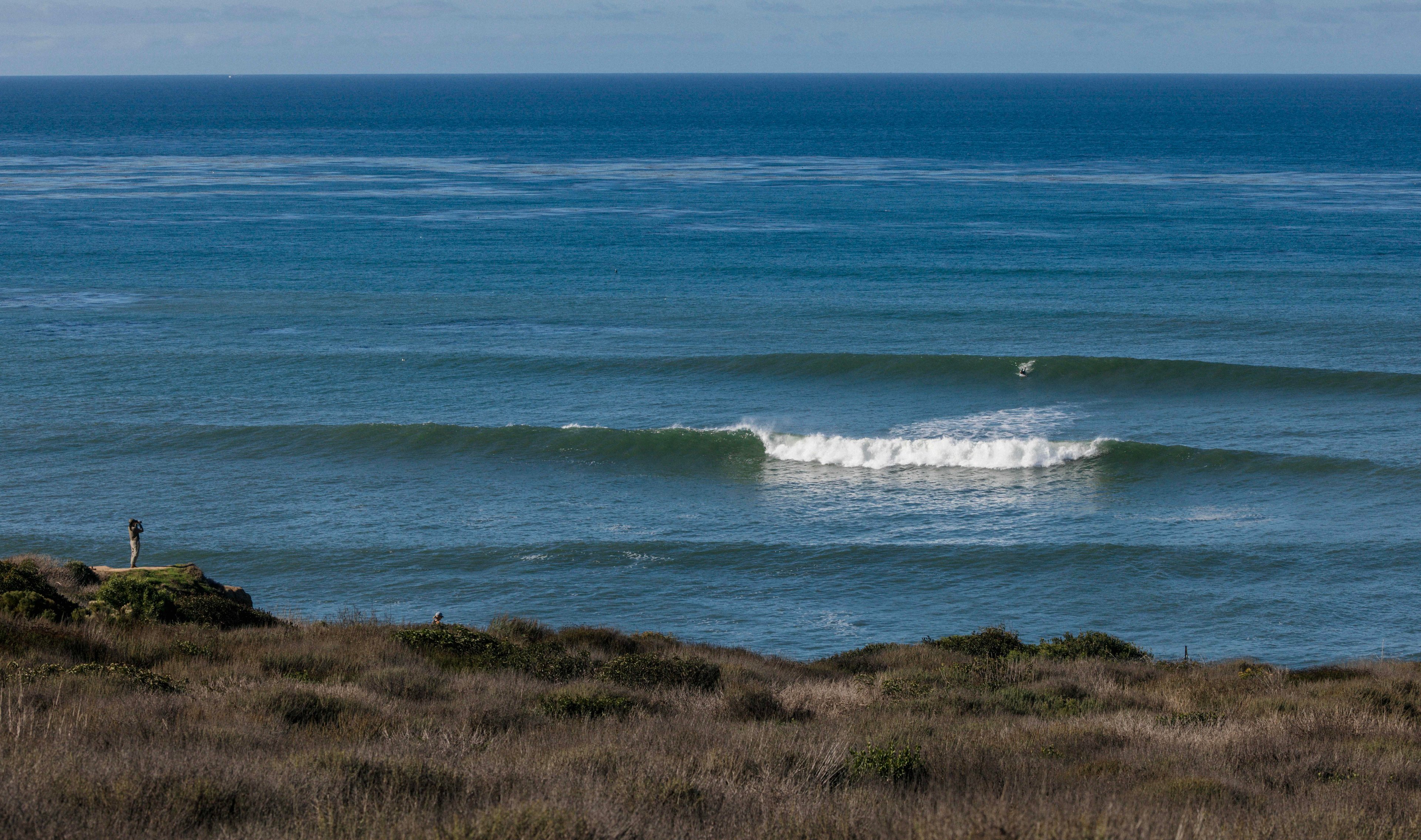
Sunset Cliffs
A thick kelp bed several hundred yards outside the break smoothes the bump out of northwesterly wind, making the Cliffs an ideal place to surf when nearby beaches are blown out. To access most of these reefbreaks, rocky cliffs -- and, often, exposed reef -- must be navigated. Long paddles mired by seagrass and kelp are the norm. There are many head-high and overhead days, but most of these spots max out before reaching eight feet. The speed of these waves is often dictated by tide. Low to mid-tide is best. Depending on the power of a swell, mid to high tide can be slower to nonexistent. Super-low tides dramatically alter the character of the breaks, making things interesting with shifting peaks and new sections. Most of the Cliffs' breaks experience long periods of doldrums in the summer. There are huge channels, and to cover all of the breaks, you'd have to paddle and surf more than three miles. Surfers inexperienced with the area are often unable to get back up the cliff trails during bigger days with higher tides. Some have been battered against the cliffs while trying to exit the water. Also, no matter how big the waves, the cliffs themselves present formidable danger. LOCAL RESOURCES: San Diego Surfrider LINEUP TIPS: Etiquette | Surf Safety Basics

Imperial Beach
IB, as it's known, breaks year-round and can hold some of the best sandbars in San Diego County. Southwest swells are received better here than most any spot in central San Diego, making it a good summertime alternative to Mexico's beaches. Medium tides work best. The shape and location of sandbars vary: sometimes it's hotter near the pier, and sometimes it's better farther south. The very end of Seacoast Drive is a popular spot. There's plenty of public parking, and, south of that, sand and ocean to one side, and wetlands to the other. Note: OB is home to some of the dirtiest water in the country, to the point that it's been closed for multiple years at a time due to bacteria.

"We’ve got reefs, jetties, a couple points. San Diego keeps us busy during pretty much every swell direction. We don't completely go flat for the summer or the winter."
When to Score & Seasonal Surf Data
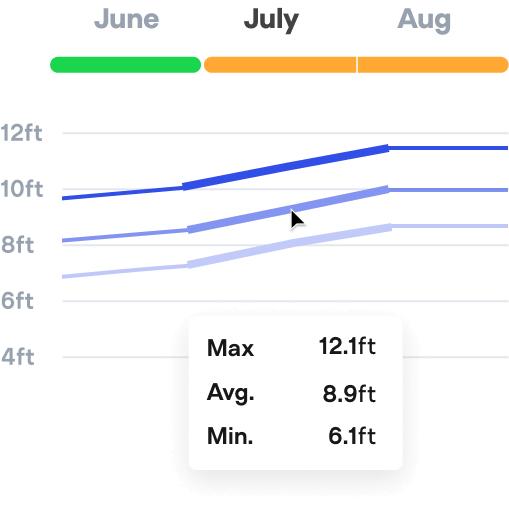
Know exactly when to score — powered by our expert historical forecast data.
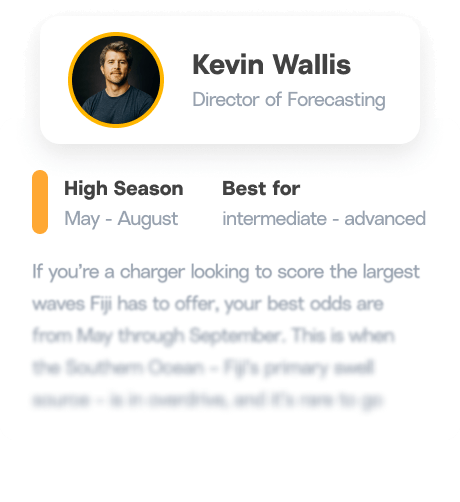
Decades of spot-specific swell info — combined with forecaster insights — show your best chance to score, found only on Surfline.
Time to score

Forecaster reports
Seasonal Surf Data

San Diego, According to...
Taylor
Knox
San Diego power surfer and all-around nice guy offers some local tips.
What makes San Diego a special destination for surfers?
It’s kinda neat — Camp Pendleton acts as a 16-mile buffer that keeps us separate, so we’re tucked down here in the corner. One of my friends calls it “the best cul-de-sac in America.” We’re right up against Baja, so we’ve got a little bit of everything — reefs, jetties, a couple of points. San Diego keeps us busy during almost every swell direction. We don’t go completely flat in summer or winter. It really does feel like our own little island.
What kind of waves can visiting surfers expect?
We’ve got sand-bottom beachbreaks, a great run of reefs through Cardiff and La Jolla, and a coastline that alternates between both. It’s beach break, reef, beach break, reef — plenty of variety. You’re not stuck with just closeout sandbars. You might have to wait for winter for the bigger stuff, but there’s always something to ride.
What’s the vibe?
You’ll often see three generations out at the same break. There’s a real community feel at many surf spots, which makes it special. It’s gotten more crowded since COVID, but overall people are mellow — not as aggressive as Malibu or anything like that. Most folks just want to surf and have fun, though things can get a little tense when people forget basic etiquette.
What should surfers bring?
In winter, bring a solid step-up — maybe a 6'6” — along with your standard shortboard for bigger swells, especially at Black’s. In summer, bring a fish and a high-performance small-wave board, and maybe even a Skip Frye glider. There are great longboard waves here too. Summer’s often trunkable, but winters get chilly — a 4/3 with booties (and maybe a hood) will do. It’s not New Jersey or Santa Cruz cold, but it’s not warm either.
When’s the best time to score?
Some people love summer for the warm water and peaky beach breaks, but my favorite time is winter. The northwest swells open up a ton of spots, from Oceanside all the way down to Imperial Beach. There’s always something firing.
What else is there to do when you’re not surfing?
San Diego’s amazing because you can go from the beach to the desert or mountains in under an hour. Julian, Mount Laguna, Point Loma — all easy day trips. There’s great fishing in summer, and the food scene has blown up everywhere from Oceanside to North Park and Downtown. Petco Park might be the best stadium in Major League Baseball, and the energy around it is awesome. Carlsbad and San Elijo campgrounds are top-notch, and there’s a thriving live music scene all over the county.
Favorite local food?
Fish 101 in Carlsbad — they have the best poke bowls, always fresh and consistent. Another great local spot is Wildland, also in Carlsbad. (Editor's note: every beach town in SD has amazing Mexican food, as well as many other options.)
Where should someone go to learn to surf?
La Jolla Shores is perfect for beginners. Oceanside has lots of surf schools. Cardiff Reef is mellow when it’s small, and Pacific Beach has tons of room to spread out. Torrey Pines is another good beginner-friendly spot.
What should visitors know about the local culture?
San Diegans are pretty laid-back. There’s a strong Latino influence here, and with Baja so close, cross-border trips are common. There’s definitely a shared connection with our neighbors to the south.
Travel Essentials
Culture and Customs
San Diego’s surf roots run deep. Skip Frye, often called the godfather of SD surfing, helped define its soul, while innovators like Tom Morey (who invented the boogie board in Carlsbad) left a global mark. Legends like Phil Edwards, Joey Buran, and the Barr brothers shaped the scene, and craftsmen like Joe Roper and Rusty Preisendorfer have kept it thriving. Rob Machado and Taylor Knox carried San Diego style to the world stage, while newer talents like Jake Marshall, Caity Simmers, and Jojo Roper keep the torch burning. With rising stars like Levi Slawson and Alyssa Spencer, SD remains a proud, fertile ground for surf talent.
Local Scene
San Diego’s got something for everyone. Dawn-patrol professors at Scripps, military surfers sneaking in sessions at Del Mar, groms on soft-tops at Tourmaline, and chargers trading sets at Black’s — it’s a diverse lineup. The abundance of breaks helps spread the crowds, but marquee spots like Windansea, Cardiff Reef, and Black’s can still get competitive. The localism isn’t harsh, but respect and patience go a long way. Find your corner of the coast, follow the lineup etiquette, and you’ll be welcomed into one of California’s most consistent surf playgrounds.
What to Bring
A step-up or even a gun works at winter NW swell magnets like Black’s, but a standard shortboard or fish handles most conditions. In summer, anything goes — longboards, fishes, whatever fits your style. For rubber: a 4/3mm (plus boots) in winter, and 3/2 or even trunks in summer and fall.
How to Get There
Fly into San Diego International Airport — most breaks are 20–30 minutes away, or 40–45 minutes to North County. From LAX, it’s a 2–3-hour drive depending on traffic.
Downtime
Snowboarding in the mountains, climbing in the desert, or Baja surf strikes — all within an hour. Closer to the coast, you’ve got fishing, boating, and camping at Carlsbad or San Elijo. The city’s food scene now rivals any in California, stretching from Oceanside to Downtown, and the live music scene thrives everywhere. Petco Park, recently voted the best stadium in MLB, adds to the energy — especially on warm summer nights. Each pocket of San Diego, from Carlsbad to Point Loma, has its own character, and together they create a region where surf, culture, and lifestyle blend seamlessly.
Quick Tips
Travel Time
JFK: 6.5 hours
Heathrow: 12 hours
Sydney: 14 hours
Connectivity
Everywhere.
Currency
USD.
Avg. cost of...
Coffee: $5.00
Lunch: $20.00
Beer: $8.00
Hotel room: $200
Visa Requirements
Yes. Depends where you're coming from. Check with your local consulate.
Drinking water quality
Fine.
Hazards
Traffic, parking tickets, sting rays in summer, water quality post-rain or near Imperial Beach/Tijuana Sloughs.
Cash, card, crypto
Credit cards are widely accepted, and access to ATMs is readily available.


Have feedback on this zone? Let us know [email protected]
Questions about booking with Surfline Travel? Check out our FAQs